
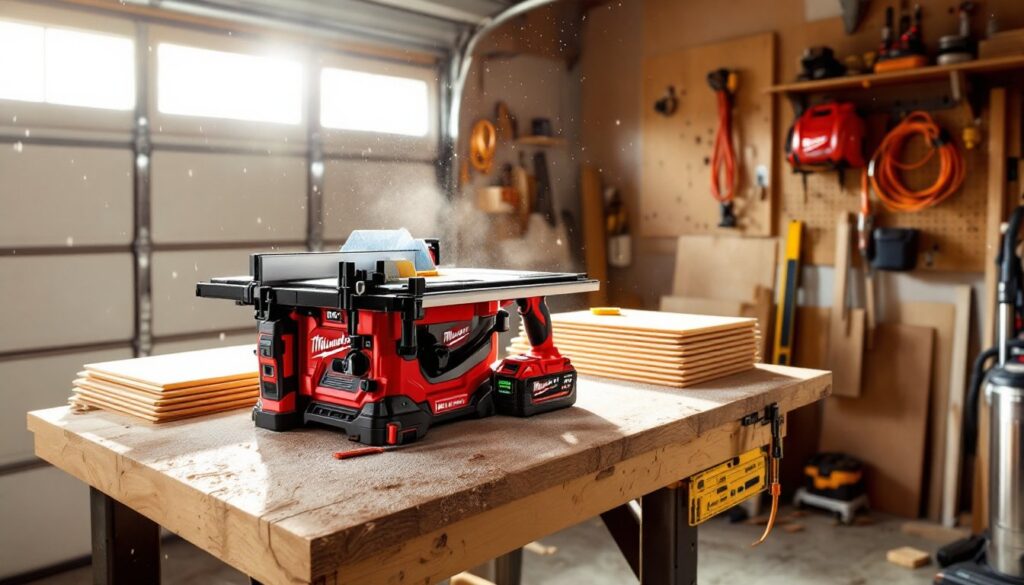

Milwaukee’s M18 Fuel table saw has shaken up what DIYers and jobsite pros expect from a cordless table saw. It’s battery-powered, compact enough to haul in a truck bed, and claims to rip through hardwood like a corded model. But does it actually hold up for weekend warriors tackling deck builds, cabinet projects, or home renovations? This guide breaks down what the M18 table saw does well, where it falls short, and whether it’s the right fit for your shop or garage. No fluff, just real-world performance, specs, and honest advice on who should (and shouldn’t) buy one.
Table of Contents
ToggleKey Takeaways
- The M18 table saw delivers cordless convenience with brushless motor technology that competes with corded 15-amp jobsite saws for most DIY projects like deck builds and cabinet work.
- At 52 lbs with an 8¼-inch blade and 24½-inch rip capacity, the M18 table saw is portable enough for jobsites without sacrificing the cutting power needed for plywood, hardwood, and pressure-treated lumber.
- Runtime varies significantly by battery: a 5.0 Ah battery cuts ~70 linear feet of plywood, while a 12.0 Ah HD battery delivers 150+ linear feet, making high-capacity batteries essential for larger projects.
- The rack-and-pinion fence system locks square and provides reliable accuracy for framing and trim work, though dust collection is adequate rather than excellent without a shop vac connection.
- The M18 table saw excels for trim carpentry, outdoor construction, and small-shop work but isn’t ideal for all-day production, fine woodworking requiring sub-1/16-inch tolerances, or dense materials without a high-capacity battery.
- Budget an additional $200–$400 for batteries and charger if you’re new to the M18 ecosystem, plus upgrades to a carbide blade and work stand for optimal performance and safety.
What Makes the M18 Table Saw Stand Out?
The M18 Fuel table saw isn’t the first cordless table saw on the market, but it’s among the first to deliver enough torque and runtime to replace a corded 15-amp saw for most DIY work. Milwaukee built this tool around their brushless motor technology, which squeezes more cutting power and battery life out of each charge compared to older brushed motors.
What sets it apart is the One-Key tool tracking (on select models) and the integration with Milwaukee’s M18 battery ecosystem. If you’re already running M18 drills, impact drivers, or circular saws, you can swap batteries across tools without buying into a new platform. That’s a cost saver and a convenience win.
The saw also includes a rack-and-pinion fence system, which locks square and stays put better than the stamped-metal fences on cheaper saws. It’s not cabinet-saw precise, but it’s reliable enough for framing lumber, plywood, and hardwood trim without constant tweaking. The 8¼-inch blade is smaller than the standard 10-inch jobsite saws, but it keeps the tool lighter and still cuts through 2x material at 45 degrees, enough for most home projects.
Key Features and Specifications
Here’s what you’re working with under the hood:
- Blade diameter: 8¼ inches (smaller than traditional 10-inch saws, but lighter and adequate for most stock)
- Max rip capacity: 24½ inches to the right of the blade (handles a full sheet of plywood ripped lengthwise)
- Depth of cut: 2⅝ inches at 90 degrees, 1¾ inches at 45 degrees
- Motor: Brushless, delivers 5,800 RPM no-load speed
- Battery compatibility: All M18 RedLithium batteries: runtime varies by capacity (see below)
- Weight: Approximately 52 lbs with battery (lighter than most corded jobsite saws)
- Fence type: Rack-and-pinion with micro-adjust and onboard storage
- Dust port: 2½-inch port for shop vac connection (dust collection is adequate, not stellar)
Runtime estimates (cutting ¾-inch plywood):
- M18 5.0 Ah battery: ~70 linear feet
- M18 HD12.0 Ah battery: ~150+ linear feet
If you’re ripping a lot of material, invest in at least one high-capacity battery or keep a second charged. Batteries are sold separately with most kits, so budget accordingly.
The saw ships with a rip fence, miter gauge, blade guard, anti-kickback pawls, and push stick. The miter gauge is basic stamped steel, functional but not ultra-precise. Upgrade to an aftermarket miter gauge if you’re doing angled joinery or crosscuts that need repeatability.
Performance in Real-World DIY Projects
Cut quality is where this saw proves itself. The brushless motor maintains speed under load, so you get clean cuts in oak, maple, and pressure-treated lumber without bogging down. Ripping ¾-inch plywood for cabinet boxes or shelf units is smooth, and the saw handles dado stacks (with aftermarket throat plate) for joinery work.
Crosscutting 2x4s and 2x6s is fast and accurate. The fence locks square out of the box, but double-check with a framing square before your first cuts, jobsite saws can shift in shipping. Bevel cuts to 45 degrees are clean, though the bevel lock could be more robust: some users report slight play after heavy use.
Dust collection works if you hook up a shop vac, but the port design doesn’t capture everything. Expect sawdust on your workbench and floor, especially with fine cuts. Wear a dust mask or respirator when working indoors or cutting treated lumber.
One caution: the anti-kickback pawls are non-removable on some cuts, which can interfere with certain non-through cuts or dado work. Plan your cuts accordingly or disable them temporarily if safe to do so (always use a push stick and proper technique).
Battery runtime is the real test. With a 12.0 Ah HD battery, you can build a small deck frame or cut all the plywood for a set of garage cabinets on one charge. A 5.0 Ah battery is fine for trimming boards or making a few cuts, but you’ll want backups for bigger projects. According to a Popular Mechanics review, the HD12.0 battery transformed the saw’s usability on remote jobsites.
Portability vs. Power: How It Compares
The M18 table saw is built for portability first, stationary work second. At 52 lbs, it’s easier to move than a typical 60–70 lb corded jobsite saw, and you don’t need an extension cord or generator. Toss it in a truck, carry it to a backyard deck site, or set it up in a garage with no outlets, that’s where it shines.
Compared to corded 15-amp jobsite saws (DeWalt DWE7491, Bosch 4100), the M18 delivers comparable rip capacity and cut quality but with slightly less raw power. Corded saws won’t bog down on thick hardwoods or long rip cuts the way a battery saw might if the charge is low. If you’re running the saw all day or cutting dense materials like laminated beams, a corded model or a larger battery is the smarter choice.
Against other cordless table saws (DeWalt FlexVolt, Makita X2), the M18 holds its own. The DeWalt FlexVolt uses two batteries for more runtime but is heavier. The Makita X2 is similarly powerful but also requires dual batteries. Milwaukee’s single-battery setup keeps the tool lighter and simpler, though you sacrifice some max runtime.
For stationary shop use, the M18 works if you already have the batteries and don’t want to run new circuits. But a corded contractor saw or hybrid table saw will give you better fence precision, larger cutting capacity, and no battery swaps. The M18 isn’t designed to replace a SawStop or a cabinet saw, it’s a jobsite/portable saw that happens to work fine in a small shop.
Best Uses for Homeowners and DIYers
The M18 table saw excels in these scenarios:
Deck and fence builds: Rip treated 2x6s and 2x4s, crosscut joists, and cut deck boards to length without dragging a corded saw across the yard.
Cabinet and furniture projects: Rip plywood for carcasses, cut hardwood for face frames, and size panels for bookcases. The fence stays square, and cut quality is clean enough for finish work (you’ll still need to sand edges).
Trim carpentry: Crosscut baseboard, crown, and casing to length. Bevel cuts for corner joints come out crisp. Pair it with a miter saw for angled cuts, but the table saw handles rips and bevels just fine.
Garage or small-shop work: If you don’t have room for a full-size contractor saw or limited outlets, the M18 fits on a folding workbench and runs off batteries. It’s quieter than most corded saws, which matters if you’re working in a shared space or attached garage.
Remote or outdoor sites: No generator, no cords, no problem. Great for barn builds, shed construction, or outdoor furniture projects where power isn’t accessible.
Not ideal for:
- All-day production work (battery swaps slow you down)
- Thick hardwoods or engineered lumber if you only own small-capacity batteries
- Fine woodworking requiring sub-1/16-inch tolerances (upgrade to a stationary saw with a better fence)
Many woodworking project plans and renovation tutorials assume you have a table saw, the M18 handles most of those tasks without being tethered to an outlet.
What to Consider Before Buying
Battery investment: The saw is often sold as a bare tool (no battery or charger). If you’re not already in the M18 ecosystem, budget $200–$400 for batteries and a dual charger. A 12.0 Ah HD battery is the sweet spot for runtime: smaller batteries are fine for light use but frustrating on bigger jobs.
Blade upgrades: The included blade is serviceable, but swap it for a 40-tooth or 50-tooth carbide blade (Freud Diablo, DeWalt precision trim) for cleaner cuts in plywood and hardwood. Thin-kerf blades reduce battery drain.
Stand or workbench: The saw doesn’t include a stand. You can use a Milwaukee folding stand (sold separately), clamp it to a workbench, or build a rolling cart. Make sure your work surface is stable and level, wobbly setups are unsafe and ruin cut accuracy.
Safety gear: Always wear safety glasses, hearing protection, and a dust mask. Table saws cause serious injuries: keep your hands away from the blade, use the blade guard and riving knife, and never reach over the blade while it’s spinning. A push stick or push block is essential for narrow rips.
Permits and codes: Table saws themselves don’t require permits, but the projects you build with them might. Deck framing, structural modifications, and electrical or plumbing work often need permits and inspections. Check local building codes before starting.
Warranty and support: Milwaukee offers a 3-year limited warranty on tools and batteries. Register your tool after purchase. Keep your receipt, warranty claims require proof of purchase.
Price: Expect $400–$500 for the bare tool, or $600–$800 for kits with batteries. That’s competitive with high-end corded jobsite saws, but only if you value cordless convenience and already own M18 batteries.
Conclusion
The M18 Fuel table saw delivers legitimate cutting power in a portable, cordless package. It’s a smart buy if you’re already invested in Milwaukee’s M18 platform, need a saw that moves between jobsites, or work in spaces without reliable power. It won’t replace a stationary cabinet saw for precision work, but it handles decks, cabinets, and trim projects with confidence. Invest in high-capacity batteries, upgrade the blade, and always follow safety protocols, this saw can do serious work if you set it up right.