
Rolling back and forth all day in an office chair isn’t just hard on your back, it’s brutal on flooring. Hardwood gets scuffed and scratched, carpet fibers crush into permanent tracks, and vinyl can crack under constant pressure. A chair mat isn’t glamorous, but it’s one of those unsexy home office upgrades that saves real money and frustration down the line. Whether someone’s converting a spare bedroom into a workspace or refreshing an established office setup, choosing the right mat means considering floor type, chair caster material, room dimensions, and how much daily use the space actually sees.
Table of Contents
ToggleKey Takeaways
- Office chair mats protect hardwood, carpet, and vinyl flooring from permanent damage caused by concentrated wheel pressure, paying for themselves by preventing repair costs of $2–12+ per square foot.
- The right office chair mat type depends on your flooring—polycarbonate or tempered glass for hard floors, and PVC or polycarbonate with cleats for carpet—each engineered for specific surface characteristics.
- Undersizing a chair mat is a common mistake; measure your full range of motion during the workday and add 6–12 inches in each direction to ensure complete floor protection.
- Proper installation on a clean floor and weekly maintenance—including vacuuming and immediate spill cleanup—extends mat lifespan to 3–7 years and prevents premature wear on both the mat and casters.
- Polycarbonate mats offer a lightweight, affordable solution for most floors, while tempered glass provides premium durability and clarity, making the choice depend on budget and expected daily use frequency.
Why Your Home Office Needs a Chair Mat
Floor damage from office chairs isn’t hypothetical, it’s guaranteed without protection. Chair casters (the small wheels on the base) exert concentrated pressure on flooring with every movement. On hardwood or laminate, this translates to visible scratches, dents, and finish wear within months of regular use. Carpet faces a different problem: the fibers compress under repeated rolling, creating worn paths that don’t bounce back even with professional cleaning.
Weight distribution is the core issue. An average office chair with a seated person concentrates roughly 150-250 pounds onto five small caster contact points. When someone rolls or pivots, those points drag across the floor surface with significant force. Hardwood floors rated for foot traffic weren’t designed for this kind of repetitive lateral stress.
Beyond aesthetics, damaged flooring affects resale value. Replacing hardwood costs $6-12 per square foot installed (as of 2026, varying by region and wood species). Carpet replacement runs $2-8 per square foot. A quality chair mat costs $30-150 and lasts 3-7 years with proper care, significantly cheaper than refinishing or replacement.
Chair mats also improve ergonomics and mobility. Rolling becomes smoother and quieter, reducing the physical effort needed to move around a desk. On carpet especially, the resistance difference is noticeable: without a mat, users often push harder than necessary, which can strain legs and core muscles during a long workday. Mats create a stable, flat surface that lets casters glide with minimal friction.
Types of Office Chair Mats for Different Flooring
Not all chair mats work on all floors. Using the wrong type accelerates wear on both the mat and the flooring underneath. The two main categories are hard floor mats and carpet mats, each engineered for specific surface characteristics.
Hard Floor Chair Mats
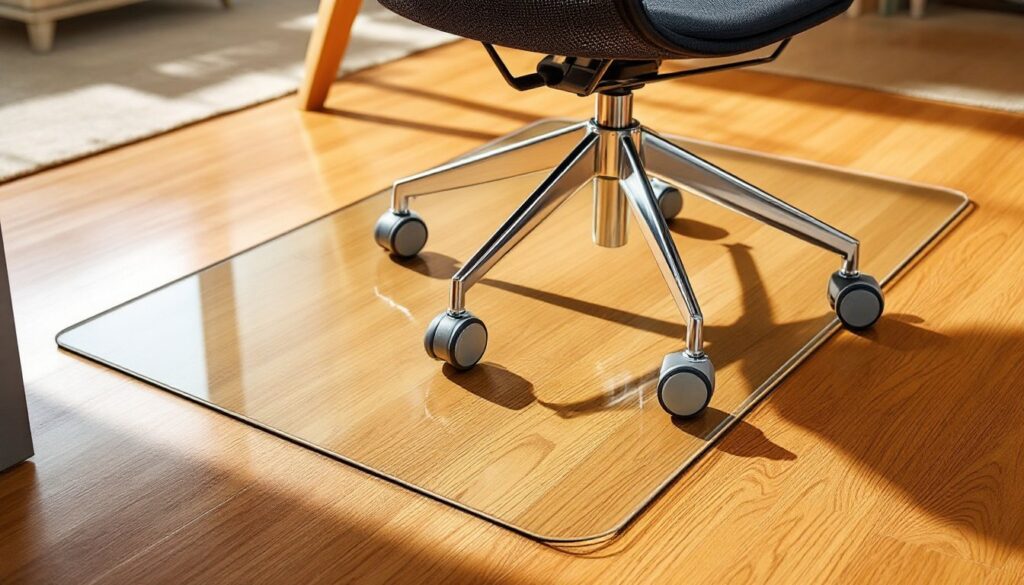
Hard floor mats are designed for wood, laminate, tile, vinyl, and concrete. They’re typically made from polycarbonate or tempered glass, both of which resist cracking under chair weight while providing a smooth rolling surface.
Polycarbonate mats are the most common. They’re lightweight, transparent (so the floor shows through), and available in thicknesses from 1/8 inch to 1/4 inch. Thicker versions (3/16″ or 1/4″) handle heavier use and users over 250 pounds. Polycarbonate can yellow slightly over time with UV exposure, but modern formulations include UV inhibitors that slow this process.
Tempered glass mats are a premium option. They don’t scratch, never yellow, and according to product testing from Good Housekeeping, they maintain clarity and structural integrity longer than polymer alternatives. The downside: they’re heavy (20-30 pounds), expensive ($150-300), and can shatter if impacted hard, though tempered glass breaks into small, less dangerous pieces rather than sharp shards.
Hard floor mats should have a smooth underside, no cleats or grips. Cleats (small spikes) are designed to anchor into carpet and will scratch hard surfaces. Some manufacturers offer “dual-purpose” mats: ignore these. They compromise performance on both surface types.
Carpet Chair Mats
Carpet mats need cleats on the underside to prevent slipping and bunching. These mats are usually made from PVC (polyvinyl chloride) or polycarbonate and come in different cleat configurations based on carpet pile depth.
For low-pile carpet (like commercial loop or tight Berber under 1/2 inch thick), standard cleats (around 1/8 inch long) provide adequate grip. For medium to high-pile carpet (plush or shag up to 3/4 inch), look for mats with heavy-duty cleats at least 1/4 inch long. The cleats need to penetrate through the carpet pile and anchor into the backing.
PVC carpet mats are budget-friendly ($30-80) but can off-gas when new, expect a plastic smell for the first few days. Let them air out in a garage or well-ventilated room before installation. Polycarbonate carpet mats cost more ($60-150) but are more durable, clearer, and odor-free.
Thickness matters on carpet even more than hard floors. A mat that’s too thin will flex and bow under a chair’s weight, negating the rolling benefit. For carpet installations, stick with mats at least 1/8 inch thick for low-pile and 3/16 to 1/4 inch for thicker carpet. Check the manufacturer’s weight rating, many inexpensive mats are only rated for users up to 200 pounds.
How to Choose the Right Size and Shape
Undersizing a chair mat is one of the most common mistakes. The mat needs to cover not just where the chair sits statically, but the full range of motion someone uses during work, rolling to reach file cabinets, turning to access a printer, leaning back, stretching out legs.
Start by measuring the workspace. Sit in the chair and roll to each position used regularly throughout the day. Mark those points with painter’s tape, then measure the resulting footprint. Add 6-12 inches in each direction as a buffer. A mat that’s too small forces users to roll onto the unprotected floor repeatedly, creating the exact damage the mat was meant to prevent.
Standard rectangular mats come in sizes ranging from 36″ x 48″ (suitable for compact desks with minimal movement) up to 60″ x 72″ (for large L-shaped or U-shaped workstations). For reference, a typical office chair has a base diameter of 24-28 inches, so even at rest it needs a mat at least 36 inches wide for comfortable clearance.
Lip extensions (also called tongue extensions) are sections that extend under a desk to protect the floor where feet rest and the chair parks when pulled in close. Many modern workspace designs incorporate standing desk converters and articulated keyboard trays, which change the chair’s parking position. If the desk has a keyboard tray, measure where the chair sits when using it, this is often 6-12 inches farther back than when using a fixed desktop.
For non-standard desk layouts, L-shapes, corner stations, or wrap-around configurations, contoured or custom-cut mats work better than trying to piece together multiple rectangular mats. Most manufacturers offer L-shaped mats in various configurations (left or right return). Some companies provide custom cutting services, though expect to pay a premium (typically 30-50% more than standard shapes).
Thickness and clearance: Measure the gap under the desk from the floor to the lowest crossbar or drawer. Chair mats add 1/8 to 1/4 inch of height. If there’s a center drawer or keyboard tray, confirm the mat won’t interfere with the chair rolling underneath when pushed in. On carpet, the mat will compress the pile slightly, but not always evenly, test fit if possible.
Don’t forget doorway clearance if the mat will be near an entry. Mats can create a tripping hazard or door swing obstruction. Trim or position accordingly, or consider a beveled-edge mat that tapers from 1/8″ at the perimeter to full thickness a few inches in.
Installation and Maintenance Tips for Long-Lasting Performance
Proper installation extends mat life and prevents the mat itself from becoming a problem. Start by thoroughly cleaning the floor. Sweep and vacuum to remove all grit, dust, and debris, particles trapped under the mat will grind into both the mat and the floor over time, causing scratches and premature wear.
For hard floor installations, lay the mat flat and let it acclimate to room temperature for 24 hours before use, especially if it was stored in a cold garage or delivered in winter. Polycarbonate can arrive slightly curled from packaging: acclimation helps it flatten naturally. If corners still curl after 24 hours, place heavy books on them overnight. Don’t use heat guns or hair dryers to speed the process, uneven heating can warp the material.
On carpet, position the mat and press down firmly to set the cleats into the pile. Walk across the entire surface to ensure even cleat engagement. If the mat slides or bunches when the chair rolls, the cleats aren’t deep enough for that carpet pile, either the mat is too thin, the cleats are too short, or the carpet is too plush for that mat style. For detailed installation techniques on various flooring types, Instructables offers user-submitted tutorials with photos of real-world setups.
Maintenance is straightforward but often neglected:
- Vacuum the mat weekly along with the floor. Debris on the mat’s surface transfers to casters, then grinds back into the mat.
- Wipe spills immediately. Coffee, soda, and other liquids can stain or weaken polycarbonate and PVC. Use a damp cloth with mild dish soap, avoid ammonia-based cleaners (like Windex), which can cloud or crack some plastics.
- Flip periodically if the mat is reversible (hard floor mats often are: carpet mats with cleats are not). This distributes wear more evenly.
- Check casters every few months. Worn or damaged casters can have sharp edges that chew up mats. Replace them with rollerblade-style casters for smoother rolling and less mat wear.
Safety note: Chair mats on hard floors can become slippery if wet. Keep them dry, and consider a mat with a textured surface if spills are likely (home offices near kitchens, for example). On carpet, loose mats are a trip hazard, if cleats don’t hold, use double-sided carpet tape around the perimeter to secure it, though this can leave residue on some carpet types.
Expect a polycarbonate or PVC mat to last 3-5 years with daily use, longer with lighter use. Glass mats can last 10+ years. Replace when cracks appear, the surface becomes pitted or rough, or the mat no longer lies flat. A damaged mat won’t protect the floor and can actually damage casters.
Conclusion
Choosing a chair mat isn’t complicated, but it’s easy to waste money on the wrong one. Match the mat type to the flooring, size it for actual use patterns (not just the chair’s footprint), and install it properly on a clean surface. A well-chosen mat pays for itself by preventing floor damage that costs multiples more to repair or replace.