
Rolling an office chair across thick carpet feels like pushing a wheelbarrow through sand. The wheels dig in, fibers compress unevenly, and over time, both the carpet and the chair suffer. A proper chair mat solves this, but not just any mat. Thick, plush carpeting (typically over 3/4 inch pile height) demands specific features that standard mats don’t provide. Thin mats crack, spikes pull out, and the whole setup slides around like a hockey puck. This guide walks through what actually works, what to avoid, and how to install a mat that stays put and performs for years.
Table of Contents
ToggleKey Takeaways
- An office chair mat for thick carpet must feature spikes measuring 1 to 1.25 inches long to penetrate through pile to the carpet backing and prevent shifting.
- Polycarbonate mats are the most durable choice for thick carpet, resisting cracking and maintaining structural integrity for years, though they cost more than PVC alternatives.
- Proper installation requires thorough vacuuming, firm pressing from center outward, and a 24–48 hour settling period before heavy use to ensure cleats fully anchor into the carpet.
- Thick carpet mats with short grippers or suction cups will slide around and accelerate carpet wear; beveled edges prevent chair wheels from jolting during entry and exit.
- Weekly soft-brush vacuuming and 6-month mat rotation prevent dirt accumulation and uneven wear patterns while maintaining long-term performance on plush carpeting.
Why Thick Carpet Needs a Specialized Chair Mat
Standard office chair mats are designed for low-pile commercial carpet or hard floors. They typically feature short grippers (under 1/2 inch) that barely penetrate thick residential carpeting. When used on plush surfaces, they rest on top of the fibers rather than anchoring into the backing.
The result? The mat shifts every time the chair moves, creating a skating rink effect. Worse, the chair wheels still compress the exposed carpet around the mat’s edges, creating visible traffic patterns and uneven wear.
Thick carpet, defined as anything over 3/4 inch pile height, including most frieze, shag, and high-density loop styles, requires mats with longer cleats (typically 1 inch or more). These penetrate through the pile to the carpet backing, distributing weight properly and preventing lateral movement.
Without adequate spike length, the chair’s casters push down through the mat, compressing the carpet beneath. Over months, this creates permanent indentations in the padding and backing. Many homeowners in luxury interior design settings discover this damage too late, after upgrading home office spaces with premium carpeting.
There’s also a safety factor. A sliding mat creates a trip hazard and makes precise chair positioning difficult, a problem when working with multiple monitors or reaching for desk items. Proper mat anchoring eliminates this instability entirely.
Key Features to Look for in Chair Mats for Plush Carpeting
Not all “thick carpet” mats perform equally. The market’s flooded with products that claim heavy-duty performance but fail within months. Here’s what actually matters.
Spike Length and Grip Technology
Cleat length is non-negotiable. For carpet over 1 inch thick (pile plus padding), look for spikes measuring 1 to 1.25 inches. These should be evenly spaced across the underside at intervals of 1 to 2 inches, tighter spacing provides better weight distribution.
Some manufacturers use a combination of long anchor cleats around the perimeter and shorter stabilizer grips across the center. This hybrid approach works well for medium-thick carpet (3/4 to 1 inch) but may underperform on deeper pile.
Check the spike material. Rigid polycarbonate cleats maintain their shape under load better than flexible PVC versions. Soft plastic spikes compress over time, reducing effective penetration depth. When reviewing product testing standards for office accessories, spike retention under cyclic loading is a key durability metric.
Avoid mats with suction cups or adhesive backing marketed for “all surfaces.” These don’t work on carpet and often damage the fibers when removed.
Material Durability and Thickness
Mat thickness affects both rolling resistance and structural integrity. For thick carpet applications, a mat should measure 3/16 to 1/4 inch thick. Thinner mats (under 1/8 inch) flex excessively, causing stress cracks at high-traffic points where the chair pivots.
Polycarbonate remains the gold standard for durability. It resists cracking in cold environments (important for basement offices), doesn’t yellow under UV exposure, and supports heavy loads without permanent deformation. Expect to pay $80–$150 for a quality 36×48-inch polycarbonate mat, though prices fluctuate with resin costs.
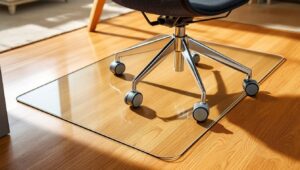
Tempered glass mats offer a premium alternative. They’re scratch-resistant, easy to clean, and visually appealing in modern office setups featured in designer home offices. But, glass mats typically lack gripping spikes and work best over very low-pile carpet or hard floors. For thick carpet, they’re not a functional choice.
PVC mats cost less ($30–$60 for similar dimensions) but contain plasticizers that off-gas over time, creating odor issues. They also become brittle with age, especially in low-humidity environments. If budget is tight, choose a thicker PVC option (at least 1/4 inch) and replace it every 2–3 years rather than expecting long-term performance.
Edge design matters more than most realize. Beveled edges (typically 15–20 degrees) prevent the mat from catching chair wheels during entry and exit. Square-edge mats create a lip that causes the chair to jolt, which accelerates wear on both the mat and the chair’s casters.
Top Chair Mat Types for Thick Carpet Applications
Three mat categories dominate the thick carpet market, each with distinct trade-offs.
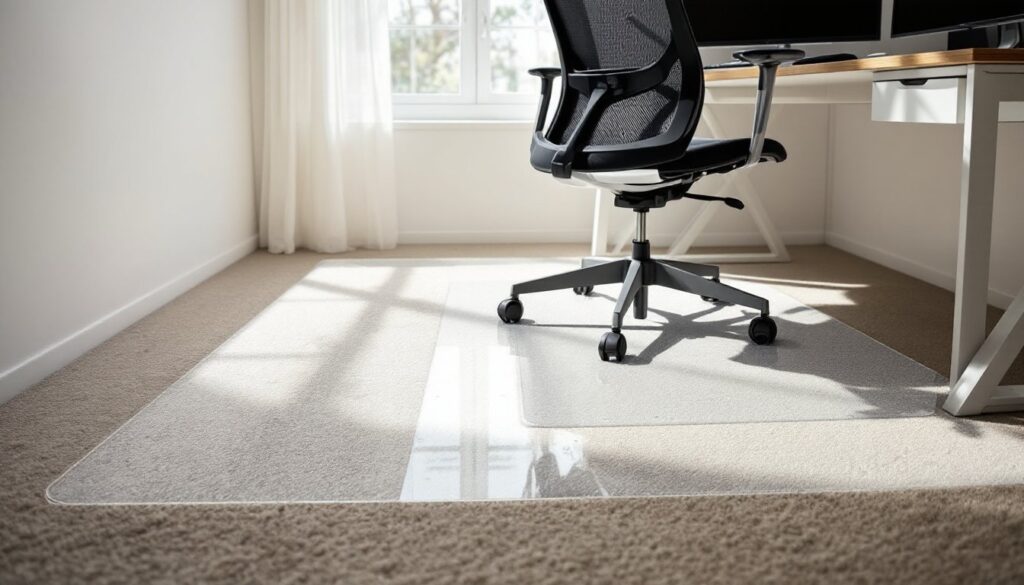
Cleated polycarbonate mats are the workhorse choice. They combine rigid spike grips with a tough surface that handles rolling traffic without cracking. Look for mats rated for carpet pile height of 1 inch or more. Most manufacturers specify compatible pile depths on the packaging, don’t guess. A standard 36×48-inch mat works for compact desks, while 45×53-inch or 48×60-inch versions suit L-shaped or executive workstations.
High-profile gripper mats feature extra-long cleats (sometimes called “deep pile cleats”) designed specifically for shag and frieze carpets. These typically measure 1.25 to 1.5 inches and provide superior anchoring. The trade-off is slightly higher rolling resistance due to deeper carpet compression. If the office chair has hard plastic casters, consider upgrading to rollerblade-style wheels (2.5 to 3 inches diameter) to reduce drag.
Modular interlocking tiles offer a flexible alternative for irregular spaces or shared work areas. Individual tiles (typically 18×18 or 24×24 inches) snap together to create custom shapes. Each tile has its own gripping cleats, so the system scales from small desk setups to full office layouts. The downside? Seams between tiles can catch small casters if not properly aligned, and per-square-foot cost runs higher than single-piece mats.
Avoid “universal” mats with flip-over designs (smooth side for hard floors, spiked side for carpet). These compromise on both applications, the spikes are usually too short for thick carpet, and the smooth side lacks the hardness needed for hard flooring.
Installation Tips for Maximum Performance and Longevity
Even the best mat fails if installed incorrectly. Here’s the process that actually works.
Step 1: Vacuum thoroughly. Remove all debris from the carpet, especially small objects that could create pressure points under the mat. Run the vacuum in multiple directions to lift the pile evenly.
Step 2: Position the mat before inserting cleats. Lay it smooth-side up (cleats facing up) in the desired location. Mark the final position with masking tape at the corners if working alone.
Step 3: Flip and press. Turn the mat over so cleats face down. Starting from the center and working outward, press down firmly on each section. For thick carpet, body weight is often necessary, walk across the mat or use a rubber mallet (wrapped in a towel to prevent surface damage) to seat the cleats fully.
Step 4: Check for rocking. The mat should sit completely flat with no wobble. If one corner lifts, the carpet pile may be uneven. Add a thin furniture pad (1/8 inch felt) under the low spot to level it out, then recheck.
Step 5: Allow settling time. Give the mat 24–48 hours before heavy use. The cleats will work deeper into the carpet backing as the fibers relax. After this period, check that the mat hasn’t shifted and re-press any edges that appear loose.
Maintenance tips: Vacuum the mat weekly using a soft brush attachment, hard beater bars can scratch polycarbonate. For spills, wipe immediately with a damp microfiber cloth. Avoid ammonia-based cleaners on polycarbonate: they cause crazing (micro-cracks). Dish soap and water work fine for routine cleaning.
Every 6 months, lift the mat and vacuum underneath. This prevents dirt accumulation that can compress carpet fibers and reduce cleat effectiveness. Rotate the mat 180 degrees if traffic patterns create uneven wear.
Safety note: Wear work gloves when handling large mats. The underside cleats are sharp enough to puncture skin, especially during initial installation. Keep fingers clear when pressing down on spiked sections.
Conclusion
Choosing a chair mat for thick carpet isn’t about finding the cheapest option, it’s about matching spike length, material durability, and mat thickness to the specific pile depth and office use pattern. Get those factors right, and the mat becomes invisible infrastructure that protects both carpet and productivity. Get them wrong, and it’s just expensive plastic that slides around while the carpet wears out anyway.